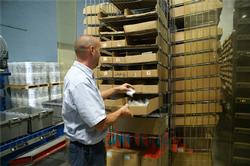
Just as what goes up must come down… in distribution “what goes in must come out”. The process of receiving a part into inventory is just as important as picking or removing the part from inventory. A little extra thought on the receiving end leads to benefits on the picking end. A solid slotting plan to receive and store parts in a facility can lead to quicker and more accurate picking distribution.
Slotting is the concept of using data analysis to create a logical process to assign every part a location based on specific attributes of the part. While the work involved in slotting items in a storage system can become very involved and complicated, at its core it can be broken into four steps.
Determining what equipment will house a part is probably the most important step, but is too often answered in a rush early on in the process based on a company’s current storage practices. Answers range from automated horizontal carousels and vertical lift modules to racks and drawer cabinets. Most storage systems can operate quite well with a handful of zones utilizing different material handling technologies. It is important to review each part individually and take into account not only how much space is required – but also how often that part is accessed. Very often parts need to be stored in various quantities and in more than one storage location or device for efficient material flow.
Next, determine how many of each part should be stored. The answer to this will almost always be “as little as possible.” For medium size and medium velocity Stock Keeping Units (SKUs) stored in a horizontal carousel, a good rule of thumb is to store a 20-day supply. This stock quantity is often used as a starting point for discussion. It offers a decent amount of stock while not requiring a tremendous amount of replenishment. Sometimes the number of parts that should be stored doesn’t match what is currently stored and changes need to be made.
Then determine what size the storage location or cell should be. It’s important to keep the number of cell sizes to a minimum. Having a small number of cell sizes will allow random storage to be incorporated effectively and will make the loading process a breeze and limit “paralysis by analysis”. Churning data can only take you so far. A hands on approach is always best, get out to the warehouse and look at the different cell sizes to determine if they are working for you.
Lastly, determine where the cell goes. Put the faster moving items in cells that are easy to access. It is important to examine the storage equipment and determine if there is a tactical advantage to storing fast movers in them. If there is, determine the best way to get your fastest movers into those cells. It is often a good idea to hold off on this step until you are at least partially through your slotting exercise, so you have a decent idea of how many of each cell size there will be. Pick density should be considered when configuring cell layouts. It is often better to store four smaller medium moving parts (say each gets 4 hits a day) in an prime, easy to access space than one larger fast moving part (say it gets 10 hits a day). By storing the 4 medium moving parts, that prime space will get 16 hits per day instead of 10.
Slotting an entire warehouse is a sizable undertaking, but the rewards greatly outweigh the time investment. When done properly, slotting can trigger a number of LEAN undertakings such as reducing obsolete inventory, minimizing stock quantities and decreasing part retrieval times to improve flow. In order to get the ball rolling, it is sometimes a good idea to focus on the fastest moving parts – in order to ensure they are being stored in an efficient quantity and location, and to gauge the immediate benefits gained from the process.
Kardex Remstar, LLC, a company of the Kardex Group is a provider of automated storage and retrieval systems for manufacturing, distribution, warehousing, offices and institutions.